Introduction: Development as a Deliberate Act
Economic development is never an accident. It is not a lottery win or a stroke of luck; it is a construction project. It does not spring from wishful thinking but from the deliberate, sometimes painstaking, “cooking together” of the critical elements of productive forces. For too long, the Nigerian mining sector has suffered from a surplus of speeches and a deficit of this precise culinary art; the ability to mix labour power, the means of labour, and the object of labour into a recipe for prosperity.
However, a shift is occurring, and its epicenter is Kaduna State. The Kaduna Mining Development Company (KMDC), under the visionary stewardship of Engr. Shuaibu Kabir Bello (S.K. Bello), has moved beyond the rhetoric of “potential” to the hard work of production. They are not merely regulators; they are developers. By refusing to hide under the convenient excuse of the Constitution’s Exclusive Legislative List, the Kaduna State Government has demonstrated that a sub-national entity can indeed drive a national mining renaissance.
This article serves as an analysis of the “KMDC Model”; a blueprint for how state governments can revolutionize Nigeria’s extractive industry. It details the strategic brilliance of its leadership, the aggressive capitalization of its assets, and its triumphant outing at the recent G20 Summit in South Africa.
The “Kaduna Model”: Refusing to Hide Under the Constitution
For decades, Nigerian states have lamented that mining is an “exclusive” federal matter, using this constitutional provision as an alibi for inaction. The Kaduna State Government, through KMDC, has shattered this alibi. Their philosophy is simple: while the Federal Government issues licenses, the State Government controls the ground, the community access, and the investment climate.
Instead of waiting for Abuja, KMDC positioned itself as a Super Partner. By acquiring its own mineral titles (over 61 titles across 23 LGAs) and entering into Joint Ventures (JVs) with private investors, KMDC effectively became a private sector player with state backing. This is the first pillar of the Kaduna Model: Don’t just regulate the table; sit at it.

The Master Chef: Engr. S.K. Bello’s Strategic Vision
No kitchen functions without a head chef who understands the chemistry of his ingredients. Engr. Shuaibu Kabir Bello has proven to be exactly that for the Nigerian mining sector. His leadership at KMDC has been defined not by sycophancy, but by a radical professionalization of the state’s mining assets.
A scholar of the Harvard Kennedy School with a background in engineering and ICT, Engr. Bello brought a data-driven rigour to KMDC. He understood early on that investors do not buy “potential”; they buy “bankable data.” His tenure has been characterized by an aggressive de-risking strategy. Under his watch, KMDC is not begging for investors; it is selecting partners.
His leadership style is anchored on “The Transition to Value.” He famously noted that KMDC is not just a mining company but a “catalyst.” This distinction is crucial. A mining company digs holes; a catalyst transforms ecosystems. By prioritizing research, digital mapping, and community integration, Engr. Bello has turned KMDC into a vehicle that protects the investor from community hostility and protects the state from resource theft.
Ingredient 1: Developing Labour Power (The Workforce)
In the Political Economy framework of productive forces, “Labour Power” is the human capacity to work. In the Nigerian mining context, this has historically been the most neglected element, represented by the chaotic and dangerous world of illegal artisanal mining.
KMDC has flipped the script on this narrative. Instead of criminalizing the artisanal miners, a strategy that has failed nationwide, Engr. Bello’s administration has moved to formalize and weaponize them.
Through the “Foot Soldiers” initiative, KMDC is organizing artisanal miners into cooperatives. These are not just paper unions; they are functional operational units that are provided with training, safety gear, and, most importantly, a legal route to market. By integrating them into the supply chains of larger investors, KMDC has converted a security threat into a skilled workforce. These miners, who know the terrain better than any satellite, now serve as the preliminary exploration team for major JVs, earning fair wages and operating under the safety umbrella of the state. This is the development of Labour Power in its purest form: upgrading the human software of the industry.
Ingredient 2: The Means of Labour (Technology & Infrastructure)
The “Means of Labour” refers to the tools and infrastructure required to produce value. For years, Nigerian mining was stuck in the “diggers and shovels” era, powered by guesswork. KMDC is aggressively pushing it into the age of beneficiation and smart data.
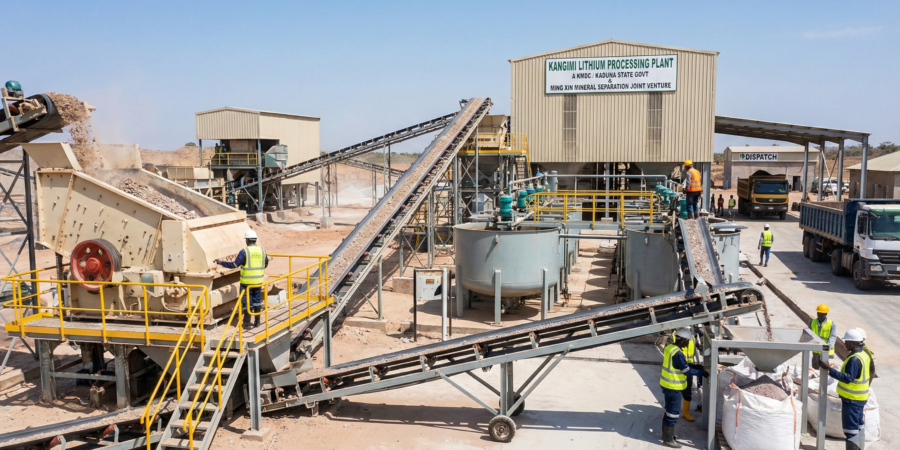
The most striking example of this is the Kangimi Lithium Processing Plant. Developed in partnership with Ming Xin Mineral Separation Nigeria Ltd, this facility represents a massive leap in the “Means of Labour.” With an initial investment of $20 million and a capacity to process 1,500 metric tonnes per day, this plant ensures that Kaduna is not just exporting ores, but exporting concentrates.
Furthermore, the “Means of Labour” includes the intellectual tools of exploration. Engr. Bello’s administration understands that you cannot mine what you cannot see profitably. The partnership with X-Calibur Smart Mapping, solidified at the recent G20 Summit, introduces airborne geophysical surveys and advanced mineral mapping to the state. This technology allows KMDC to see deep into the earth, identifying deposits of Lithium, Gold, and Nickel with a precision that eliminates the gambling aspect of exploration. By providing this high-level data, KMDC provides the ultimate tool to investors: certainty.
Ingredient 3: The Object of Labour (Value Addition & Resource Optimization)
The “Object of Labour” is the raw material itself, but in a developmental context, it is about how that material is valued and treated. The “dig and ship” mentality treats the object of labour as a cash crop. KMDC treats it as an industrial base. Engr. Bello’s KMDC fundamentally recognizes that the exportation of unprocessed mineral ores is an archaic and unsustainable economic model.
This is evident in the above-mentioned Kangimi Lithium Processing Plant and the Jema’a Resource Project. Following the discovery of substantial deposits of Gold, Lithium, Copper, and Nickel in the Gidan Waya axis, KMDC did not rush to sell licenses. Instead, they formed a Special Purpose Vehicle (SPV) to develop the asset themselves in partnership with technical experts. By retaining equity in the object of labour, the state ensures that the wealth generated remains in Kaduna.
This strategy was further bolstered by the launch of the $150 Million Green Mining Investment Fund. This is perhaps the most sophisticated financial instrument ever deployed by a Nigerian state in the mining sector. By creating a dedicated fund to co-finance drilling and project preparation for “green minerals” (Lithium and Rare Earth Elements), KMDC is directly intervening to increase the value of the Object of Labour before it even leaves the ground. They are banking on the global energy transition, positioning Kaduna’s rocks as the batteries of the future.
Global Validation: The G20 Summit Outing in South Africa
The efficacy of the KMDC model was displayed on the global stage at the recently concluded G20 Summit in South Africa (November 2025). While many delegations went for photo-ops, the Kaduna State delegation, led by Governor Uba Sani and anchored technically by Engr. Bello, went for business.
The summit was a harvest of credibility for KMDC. The signing of five strategic Memoranda of Understanding (MoUs) was not just a diplomatic formality; it was a market validation.
- Core International: The agreement to secure anchor capital for the $150m Green Mining Fund proves that global finance trusts Kaduna’s governance structure.
- X-Calibur Smart Mapping: A deal to deploy cutting-edge technology for mineral exploration.
- Vuka Group: A partnership to integrate Kaduna into the broader African mining conversation.
- Rosebank Capital: Secured for transaction advisory, ensuring that deals are structured to international standards.
- DCX Global & Precious Metals Tswane: A critical agreement to establish a gold aggregation and processing center.
These agreements fundamentally change the “Object of Labour” from raw minerals into financial assets. The G20 outing proved that when a state organizes its “kitchen” correctly, mixing the right labor policies with the right infrastructure and value-addition strategies, the world will come to dine.
Conclusion: The KMDC Blueprint
The Kaduna Mining Development Company has provided a definitive answer to the question of how Nigeria can diversify its economy. It is not through federal fiat, but through state-level innovation.
Engr. S.K. Bello and his team have successfully “cooked” the three elements of productive forces. They have dignified the Labour Power of the artisan; they have modernized the Means of Labour through processing plants and smart mapping; and they have maximized the Object of Labour by focusing on green minerals and value addition.
As the Nigerian Mineral Exchange (NME) champions models of success for sectoral development, KMDC stands tall as the definitive benchmark in the Nigerian mining industry. Its success validates the principle that economic transformation is a product of design, not chance. By combining the professional rigour of Engr. Bello, with the supportive policy environment created by Governor Uba Sani, KMDC has demonstrated that sub-national governments can effectively drive the industry, proving their capacity to move mountains, literally and figuratively.
Read Also:
Kaduna State Mining Sector: An Overview
The Ultimate Guide to Starting a Mining Company in Nigeria
The Nigerian Mineral Processing Industry: Unlocking a N3 Trillion Opportunity