
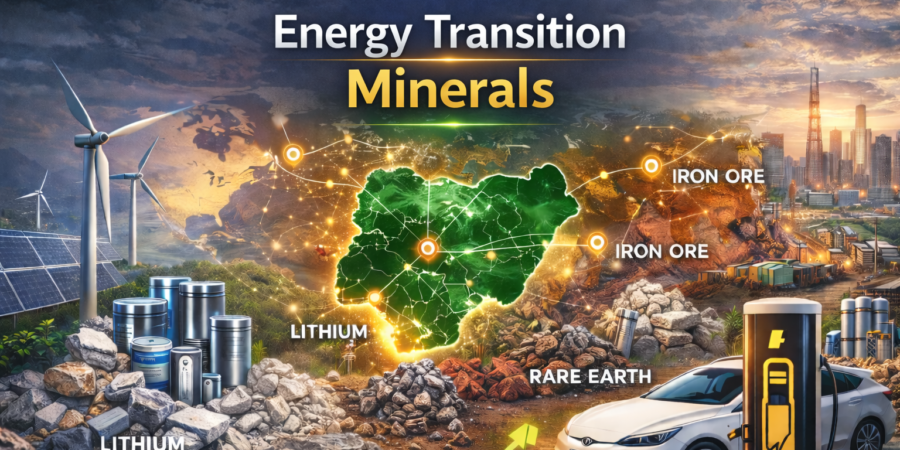
Lithium, Tin, Rare Earths, and Nigeria’s Emerging Role in Future Supply Chains
The global transition toward cleaner energy systems is reshaping the demand for mineral resources around the world. As countries accelerate efforts to reduce carbon emissions and expand renewable energy technologies, the need for certain minerals, often referred to as critical minerals, has increased dramatically.
Critical minerals play a central role in technologies such as electric vehicles, renewable energy systems, battery storage, electronics, and advanced manufacturing. These materials form the backbone of the energy transition and the emerging low-carbon global economy.
While much attention has been focused on established mineral-producing countries, several emerging mining jurisdictions are increasingly gaining attention due to their geological potential.
Nigeria is one such country.
With deposits of lithium, tin, columbite, rare earth elements, and other strategic minerals, Nigeria is gradually entering discussions about the future of critical mineral supply chains.
Understanding Nigeria’s role in this evolving landscape requires examining both the global demand for critical minerals and the country’s own mineral resource potential.
The Global Race for Critical Minerals
The global energy transition is driving one of the most significant shifts in mineral demand in modern history.
Electric vehicles require large quantities of lithium, nickel, cobalt, graphite, and rare earth elements. Wind turbines depend on rare earth magnets. Solar energy systems rely on various industrial minerals and metals. Modern electronics require tin, tantalum, and other specialized materials.
According to many international energy and mining analyses, demand for several critical minerals is expected to increase substantially over the coming decades.
For example:
- Lithium demand is projected to grow rapidly due to battery production.
- Rare earth elements are essential for high-performance magnets used in wind turbines and electric motors.
- Tin and tantalum are important components in electronic devices and semiconductors.
As countries compete to secure stable mineral supply chains, attention has turned toward regions that host underdeveloped mineral resources.
Africa has increasingly emerged as an important part of this conversation.
Africa’s Growing Importance in Mineral Supply Chains
Africa possesses significant mineral resources that are critical to the global energy transition.
Several countries across the continent already play important roles in global supply chains. For example:
- The Democratic Republic of Congo produces much of the world’s cobalt.
- Mozambique hosts important graphite deposits.
- Zimbabwe has emerging lithium projects.
- Namibia and South Africa are known for rare earth and battery mineral deposits.
These developments have positioned Africa as a region of strategic importance in the evolving global mineral landscape.
Nigeria, with its diverse geology and historical mining heritage, is gradually attracting attention as well.
Critical Minerals Found in Nigeria
Nigeria hosts several minerals that are increasingly important to modern technologies and industrial systems.
Some of the most notable critical minerals found in Nigeria include lithium, tin, columbite, and rare earth elements.
Lithium Deposits in Nigeria
Lithium has become one of the most sought-after minerals in the global energy transition due to its central role in rechargeable battery production.
Lithium-ion batteries power electric vehicles, energy storage systems, mobile devices, and numerous other technologies.
Recent exploration activities have identified lithium deposits in several parts of Nigeria, particularly in states such as:
- Nasarawa
- Kaduna
- Kogi
- Plateau
- Kwara
- Niger
- Kebbi
These discoveries have generated growing interest from international investors and mining companies seeking new sources of battery minerals.
While exploration and development activities are still evolving, Nigeria’s lithium resources could potentially contribute to global supply chains supporting electric mobility and renewable energy technologies.
Tin and Columbite
Tin has historically been one of Nigeria’s most important mineral resources. During the early twentieth century, Nigeria was among the world’s major tin producers, particularly in the Jos Plateau region.
Tin remains an essential component in modern electronics manufacturing. It is widely used in soldering materials that connect electronic components in circuit boards.
Columbite, which often occurs alongside tin deposits, is another important mineral used in the production of tantalum; an element used in capacitors and electronic devices.
As global demand for electronic products continues to grow, these minerals remain important components of global supply chains.
Rare Earth Elements
Rare earth elements are a group of minerals used in many advanced technologies.
They are essential for manufacturing high-strength magnets used in:
- wind turbines
- electric vehicle motors
- electronics
- defense technologies
Several rare earth mineral occurrences have been identified in Nigeria, although exploration activities remain at relatively early stages.
With growing global demand for rare earths and increasing interest in diversifying supply chains, these resources could become strategically important in the future.
Nigeria’s Opportunity in the Energy Transition
Nigeria’s mineral resources present a unique opportunity to participate in the global transition toward cleaner energy systems and advanced technologies.
While the country has traditionally been known for its petroleum industry, the global shift toward renewable energy has created new opportunities for mineral-rich economies.
Nigeria’s lithium, tin, and rare earth minerals could potentially contribute to supply chains supporting:
- electric vehicle batteries
- renewable energy infrastructure
- electronics manufacturing
- energy storage technologies
However, realizing this opportunity will require sustained investment in exploration, responsible mining practices, and improved coordination across the mining ecosystem.
The Infrastructure Challenge
Like many emerging mining jurisdictions, Nigeria faces several structural challenges that can affect the development of its mining sector.
These challenges include:
- limited geological data availability
- infrastructure constraints in mining regions
- access to financing for exploration projects
- fragmented industry information
- limited visibility for mining opportunities
In many cases, investors seeking to understand Nigeria’s mining sector may struggle to identify reliable information about mineral opportunities, technical service providers, or exploration activities.
This highlights the importance of developing market infrastructure that organizes information and strengthens connections across the ecosystem.
The Role of Market Infrastructure in Emerging Mining Economies
Market infrastructure refers to the systems that enable participants within an industry to interact effectively.
In mature mining jurisdictions, various forms of infrastructure help support the ecosystem. These include industry data platforms, mineral exchanges, professional service networks, and sector intelligence systems.
Such platforms help investors identify opportunities, enable miners to access services, and improve transparency across the industry.
For emerging mining economies like Nigeria, developing these systems can significantly strengthen sector coordination.
Digital platforms can play a particularly important role in this process.
The Nigerian Mineral Exchange
The Nigerian Mineral Exchange (NME) was developed as a digital platform designed to help organize Nigeria’s mining ecosystem.
The platform aims to improve access to mining intelligence, increase visibility for mineral opportunities, and connect participants across the sector.
Today, the Nigerian Mineral Exchange hosts:
- mining sector information resources
- research publications and industry insights
- mineral listings and trading opportunities
- directories of equipment suppliers and service providers
- mining opportunity listings for investors
By bringing these elements together within a structured digital environment, the platform helps reduce information barriers and improve visibility across Nigeria’s mining ecosystem.
The platform can be accessed online at:
www.nigerianmineralexchange.com
Strengthening Nigeria’s Mining Ecosystem
As global demand for critical minerals continues to grow, countries with untapped mineral resources have an opportunity to participate in emerging supply chains.
For Nigeria, realizing this opportunity will require several key developments, including:
- increased exploration activities
- responsible mining practices
- improved geological data availability
- investment in mineral processing and value addition
- stronger ecosystem coordination
Digital platforms that organize mining intelligence and improve access to information can help support these developments by making it easier for investors and industry participants to discover opportunities.
For a comprehensive overview of Nigeria’s mining sector, see our Complete Guide to Nigeria’s Mining Industry.
Looking Ahead
The global energy transition is reshaping mineral demand in ways that will influence the mining industry for decades to come.
Minerals such as lithium, tin, and rare earth elements are becoming increasingly important as the world expands renewable energy systems and electrified transportation.
Nigeria’s mineral resources place the country within this evolving landscape.
While the sector is still developing, Nigeria’s geological potential, growing investor interest, and expanding mining ecosystem suggest that the country could play a meaningful role in future mineral supply chains.
As the mining sector continues to evolve, improved access to information, stronger industry coordination, and the development of market infrastructure will be essential for unlocking these opportunities.
The Nigerian Mineral Exchange represents one step toward building the systems that can support this transformation.
Obinna Ede
Founder & System Architect, Nigerian Mineral Exchange
Mining Market Infrastructure & Investment Intelligence
READ Also:
Top Mining Opportunities in Nigeria: A Guide for Investors and Industry Participants
Building Nigeria’s Mineral Market Infrastructure: The Nigerian Mineral Exchange Vision
How to Invest in Nigeria’s Mining Sector: A Step-by-Step Guide for Foreign Investors



Leave a Reply