
Nigeria’s mining industry is entering a decisive new phase; one that could redefine the country’s position in the global resource economy for decades to come.
For years, conversations around Nigeria’s solid minerals sector have centered on untapped potential. The country possesses vast deposits of lithium, gold, tin, limestone, barite, rare earth elements, and other strategic minerals spread across multiple states. Yet despite this abundance, the sector has remained constrained by fragmentation, limited industrial capacity, weak market systems, inadequate technology integration, and a long-standing dependence on raw mineral exports. Today, however, a different model is beginning to emerge.
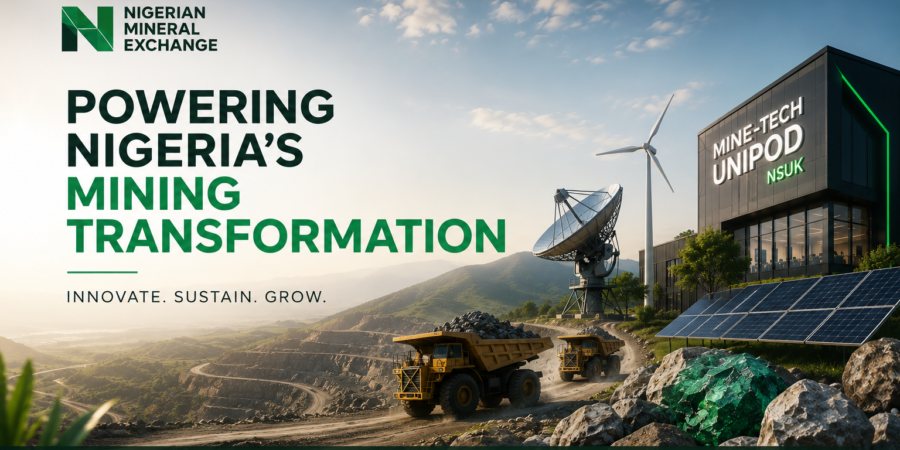
At Nasarawa State University, Keffi (NSUK), the launch of the Mine-Tech UniPod by the United Nations Development Programme (UNDP), in collaboration with the Federal Government of Nigeria and key institutional stakeholders, signals more than the establishment of another innovation hub.
It signals the early architecture of a new industrial direction for Nigeria; one built around innovation, value addition, digital systems, sustainability, and integrated mining ecosystems. The message is clear: Nigeria is attempting to move from extraction to innovation.
A Shift Beyond Raw Mineral Extraction
Historically, much of Nigeria’s mining economy has functioned within an extractive framework. Minerals were dug from the ground, sold through fragmented channels, and exported with limited local processing or industrial integration.
This model created several structural problems:
- limited value retention within Nigeria
- weak industrial linkages
- informal trade networks
- low technological adoption
- and insufficient participation in global high-value supply chains
Meanwhile, countries that invested in mineral processing, industrial ecosystems, and innovation infrastructure captured significantly greater economic value from the same resources.
The launch of the Mine-Tech UniPod reflects a growing recognition that Nigeria must reposition itself within the global mining economy; not merely as a source of raw materials, but as a participant in the broader industrial and technological value chain. This transition is particularly important at a time when critical minerals are becoming central to the global energy transition.
Lithium, graphite, cobalt, rare earth elements, and other strategic minerals now power:
- electric vehicles
- battery systems
- renewable energy infrastructure
- semiconductors
- advanced manufacturing technologies
As global demand accelerates, countries capable of combining mineral resources with innovation, processing capacity, and industrial systems will hold significant strategic advantage.
The Rise of UniPods as Innovation Infrastructure
The Mine-Tech UniPod is part of a broader national UniPod initiative designed to reposition Nigerian universities as engines of innovation and economic transformation.
Rather than functioning solely as academic institutions, universities are increasingly being integrated into national development systems, supporting enterprise creation, industrial research, technology commercialization, and workforce development.
Across Nigeria, UniPods are now being established around specialized sectors, including:
- Artificial Intelligence
- Green and Blue Economy Technologies
- Industrial Manufacturing and Trade
- Resilience Technologies
- Agriculture and Food Systems
- Mine-Tech Innovation
This represents a major strategic shift. Instead of isolated innovation programs, Nigeria is beginning to build interconnected innovation infrastructure aligned with national economic priorities.
In this framework, universities become:
- research centers
- industrial laboratories
- startup incubators
- and regional innovation anchors
The Mine-Tech UniPod at NSUK serves as the mining-focused node within this emerging national architecture.
Why Nasarawa State Matters
The location of the Mine-Tech UniPod is highly strategic.
Nasarawa State sits within Nigeria’s mineral-rich Middle Belt and has increasingly emerged as a focal point for mining investment and industrial development. Its proximity to Abuja provides direct institutional and policy access, while its geological endowment positions it as a critical zone within Nigeria’s growing critical minerals economy.
Recent developments including lithium processing investments and expanding mineral exploration activities, have strengthened Nasarawa’s reputation as one of Nigeria’s emerging mining and green industrialization hubs.
This combination of:
- mineral resources
- institutional access
- industrial momentum
- and innovation infrastructure
makes it an ideal environment for testing and scaling a new mining ecosystem model.
The Mine-Tech UniPod as a Full-Stack Mining Ecosystem
One of the most important aspects of the Mine-Tech UniPod is that it is not being developed as a standalone laboratory or isolated research center. Instead, it is being structured as a multi-layered mining innovation ecosystem integrating multiple components of the mining value chain. This distinction is critical. What is emerging at NSUK is not simply mining research, it is system architecture.
1. Governance and Regulatory Digitalization
At the foundation of the ecosystem is the digitization of mining governance.
The Electronic Mining Cadastre Plus (eMC+) platform modernizes mineral title administration by enabling transparent licensing processes, digital tracking, and improved access to regulatory information.
This is significant because uncertainty and opacity in licensing systems have historically discouraged investment and slowed sector development.
Digital governance systems reduce friction, improve transparency, and strengthen institutional trust within the industry.
2. Exploration Intelligence and Geospatial Systems
The ecosystem also incorporates advanced exploration intelligence tools designed to improve mineral discovery and resource planning.
These include:
- AI-powered mineral prediction systems
- geospatial intelligence platforms
- national mineral data systems
- investor-oriented geological databases
Together, these technologies shift exploration away from speculative approaches toward data-driven decision-making. This reduces risk for investors while improving efficiency across exploration activities. In practical terms, this becomes the intelligence layer of the mining ecosystem.
3. Knowledge Infrastructure and Digital Libraries
Another major component is the development of structured knowledge systems. For decades, critical mining information across Nigeria has remained fragmented, inaccessible, or poorly documented. The introduction of digital mining libraries and centralized knowledge platforms helps consolidate:
- technical resources
- research outputs
- regulatory guidance
- geological data
- industry intelligence
This creates long-term institutional memory while supporting education, training, and innovation. Knowledge infrastructure is often overlooked in mining conversations, but it is essential for building sustainable industrial capacity.
4. Processing Technologies and Value Addition
Perhaps the most transformative layer is the emphasis on mineral processing and value addition.
Nigeria has historically exported significant volumes of raw minerals while capturing only a fraction of their potential value. The Mine-Tech UniPod seeks to challenge this pattern through technologies such as:
- Direct Lithium Extraction (DLE)
- advanced mineral processing systems
- cleaner artisanal processing methods
- materials development and testing
This aligns directly with the Federal Government’s increasing emphasis on local beneficiation and industrial processing. The objective is no longer simply extraction. It is industrial transformation.
5. Sustainability and Green Mining Systems
The ecosystem also integrates sustainability and ESG-focused mining technologies. As global mining standards evolve, environmental responsibility, traceability, and social impact are becoming increasingly important in international mineral markets.
The Mine-Tech UniPod includes initiatives focused on:
- green mining technologies
- ESG compliance systems
- environmental monitoring
- sustainable mineral development
This positions Nigeria more competitively within evolving global supply chains that increasingly prioritize responsible sourcing.
6. Community Integration and Artisanal Mining
One of the most important dimensions of the initiative is the inclusion of artisanal and small-scale miners (ASM).
Rather than excluding informal operators, the ecosystem seeks to integrate them through:
- safer mining practices
- cooperative systems
- financial management tools
- digital integration
- market access solutions
This is particularly important because artisanal miners represent a significant portion of Nigeria’s mining activity. Formalization cannot succeed without their inclusion.
7. Digital Trade Infrastructure and Market Systems
Innovation alone cannot transform an industry without functioning market systems.
This is where digital trade infrastructure becomes essential.
As Nigeria’s mining ecosystem evolves, platforms that enable:
- market visibility
- stakeholder coordination
- structured transactions
- and access to global markets
will play an increasingly central role.
Digital marketplaces such as the Nigerian Mineral Exchange (NME) represent part of this emerging infrastructure layer; connecting miners, buyers, investors, equipment providers, and service companies within a more organized ecosystem.
This transition from fragmented trade networks toward structured digital systems may ultimately become one of the defining shifts within Nigeria’s mining economy.
The Bigger National Vision
The Mine-Tech UniPod is not an isolated initiative.
It reflects a broader national ambition:
- industrial diversification
- critical minerals development
- innovation-led growth
- and participation in the global green economy
Nigeria’s mineral resources have often been described as being worth trillions of dollars in untapped potential. But natural resources alone do not create prosperity.
What creates prosperity are:
- institutions
- systems
- industrial capacity
- innovation ecosystems
- and functioning markets
That is the deeper significance of the Mine-Tech UniPod. It represents an attempt to build these systems.
From Resource Economy to Knowledge Economy
What is happening at NSUK ultimately reflects a larger transition taking place across global resource industries. The future of mining will not belong solely to countries with minerals.
It will belong to countries capable of integrating:
- technology
- data
- processing
- sustainability
- research
- and market systems
into cohesive industrial ecosystems.
This is the difference between a resource economy and a knowledge-driven mining economy. And this is the transition Nigeria is now attempting to make.
Conclusion: The System Is Beginning to Form
Nigeria’s challenge has never been the absence of minerals. The challenge has been structure. For decades, the sector operated within fragmented systems that limited value creation, industrial development, and global competitiveness.
What the Mine-Tech UniPod represents is the beginning of a different approach.
An approach where:
- universities become industrial innovation engines
- digital systems support governance and trade
- processing replaces raw exports
- and mining evolves into a connected ecosystem rather than isolated activities
The significance of this shift cannot be measured merely by the launch of a facility. Its true significance lies in the systems now being assembled around it. Nigeria is no longer simply discussing mining potential. It is beginning to build the architecture required to unlock it.
READ ALSO
Building Nigeria’s Mineral Market Infrastructure: The Nigerian Mineral Exchange Vision
Inside the NSUK Mine-Tech UniPod: Powering Nigeria’s Green Mining Future
Beyond Oil: Nigeria’s Mining Sector Hits $2.6 Billion Investment Milestone in 2026
Top Mining Opportunities in Nigeria: A Guide for Investors and Industry Participants
How to Invest in Nigeria’s Mining Sector: A Step-by-Step Guide for Foreign Investors


Leave a Reply