
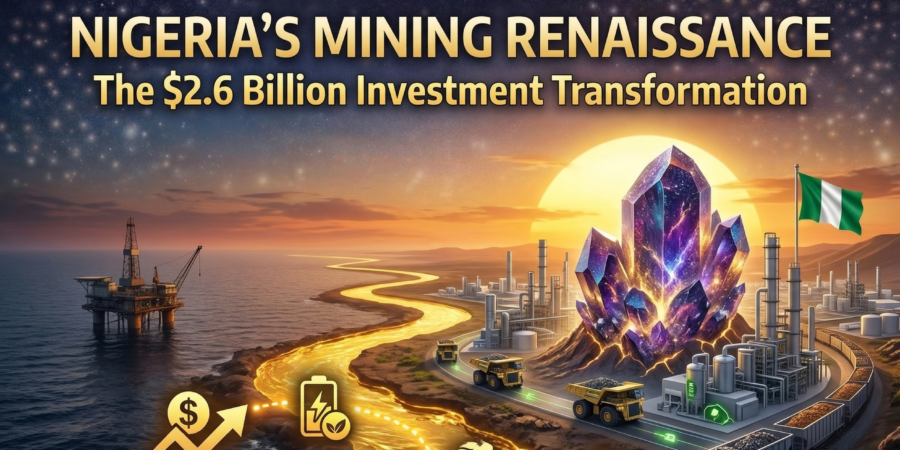
ABUJA – Nigeria’s long-anticipated transition from an oil-dependent economy to a solid minerals powerhouse has reached a historic turning point. As of March 2026, the Federal Government has officially announced that the sector attracted over $2.6 billion in Foreign Direct Investment (FDI) within the last 30 months, signaling a massive return of investor confidence in the nation’s hidden wealth.
The $2.6 Billion Windfall
The Minister of Solid Minerals Development, Dr. Dele Alake, speaking at the Powering Africa Summit in Washington, D.C., attributed this surge to aggressive policy reforms under the President Bola Ahmed Tinubu administration. The $2.6 billion inflow represents a staggering increase compared to the previous decade, where the sector contributed less than 1% to the national GDP.
“We have successfully de-risked and sanitized the mining environment,” Alake stated. “Our reforms now guarantee secure tenure for mineral titles, providing the long-term stability that global giants require before committing capital.”
Key Drivers of the Boom
The Mining Renaissance is being fueled by three strategic pillars:
- The Lithium Rush: Nigeria has emerged as a critical player in the global electric vehicle (EV) supply chain, with massive lithium-bearing pegmatite belts in Kwara, Kaduna, and Nasarawa attracting $600 million in dedicated processing plant investments.
- The Mining Marshals: To protect these investments, the government deployed over 2,200 specialized Mining Marshals. In the last year alone, they have arrested over 350 illegal miners, including several foreign nationals, sending a clear message that the Wild West era of Nigerian mining is over.
- Digital Transparency: The total digitization of the Mining Cadastre Office now allows investors to track license applications and approvals transparently, removing the bureaucratic bottlenecks that once fueled corruption.
Mandatory Value-Addition
In a bold departure from the past, Nigeria has ended the pit-to-port model. New mining licenses now mandate that at least 30% of output must be processed locally before export. This policy is already bearing fruit, with the recent $1.3 billion deal with the Africa Finance Corporation (AFC) to build a one-million-ton-per-year alumina refinery.
“Our vision is crystal clear: no mineral leaves Nigeria unprocessed. We are determined to add value where value is created, right here in Nigeria.” – Dr. Dele Alake
What’s Next for Investors?
The government is currently offering a suite of incentives to maintain this momentum:
- Tax Waivers: Zero duty on all imported mining equipment.
- Profit Repatriation: 100% repatriation of profits after royalties and taxes.
- Data Access: Expanded access to internationally certified geological data to reduce exploration risks.
With the sector now on track to contribute 10% to Nigeria’s GDP by the end of the year, the Solid Mineral Renaissance is no longer just a policy goal, it is a $2.6 billion reality.
READ Also:
Top Mining Opportunities in Nigeria: A Guide for Investors and Industry Participants
Building Nigeria’s Mineral Market Infrastructure: The Nigerian Mineral Exchange Vision
How to Invest in Nigeria’s Mining Sector: A Step-by-Step Guide for Foreign Investors
Leave a Reply