
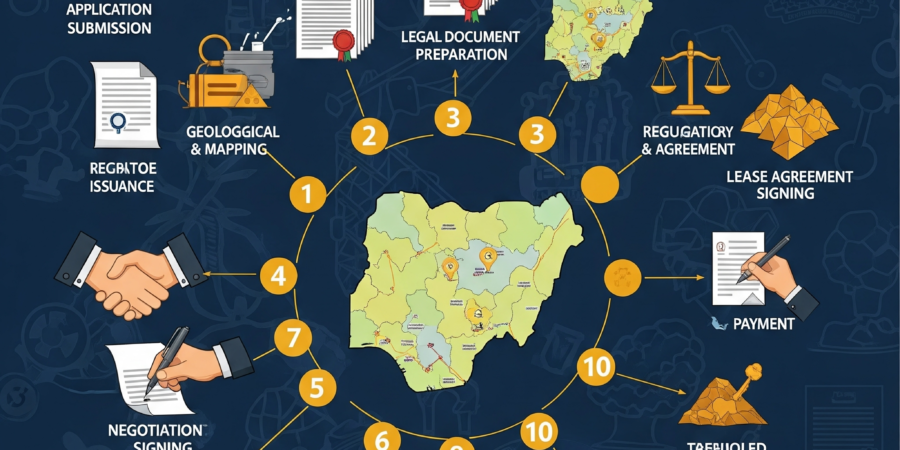
Securing a Mining Lease (ML) is the ultimate goal for any serious investor or company looking to undertake large-scale mining operations in Nigeria. Unlike other licenses, an ML grants you the exclusive right to mine, process, and market a specific mineral within a designated area for up to 25 years. However, the process is meticulous, demanding a high degree of compliance and technical expertise.
This guide provides a definitive, 10-step roadmap to acquiring your Mining Lease in Nigeria.
The Legal and Technical Pre-requisites
Before you can even begin your application, you must satisfy a few non-negotiable legal and technical requirements that establish your eligibility.
- You Must Be a Company: Only a company duly incorporated with the Corporate Affairs Commission (CAC) is eligible to apply for a Mining Lease. Individuals are not permitted to hold this title.
- You Must Hold an Exploration License: A Mining Lease cannot be acquired in isolation. It is a direct progression from an Exploration License (EL). You must have conducted a successful exploration program and proven the existence of a commercial quantity of minerals.
- You Must Demonstrate Technical and Financial Competence: The Mining Cadastre Office (MCO) requires robust evidence of your company’s financial capability and technical competence to carry out a full-scale mining operation. This includes a bank reference letter, a verifiable statement of account, and a detailed list of your key technical staff (e.g., geologists, mining engineers) with their qualifications and employment letters.
The 10-Step Mining Lease Acquisition Process
Step 1: Conduct Due Diligence and Site Reconnaissance: The first step is to identify and confirm a mineral-rich area that is free from any other title. The MCO operates on a “first-come, first-served” basis, so a thorough search is critical. You must also obtain irrevocable consent from the landowners or occupiers of the target area.
Step 2: Obtain an Exploration License (EL): If you do not already have one, you must first apply for and secure an EL from the MCO. This license is essential for conducting a proper exploration program.
Step 3: Conduct a Feasibility Study: This is the most crucial part of your application. The feasibility study must be stamped and signed by a member of the Council of Mining Engineers and Geoscientists (COMEG). The study must detail the commercial viability of the deposit, including the proven reserves, grade, mine plan, and financial projections.
Step 4: Prepare a Detailed Mine Plan: You must submit a comprehensive mine plan and design that outlines your proposed mining operations, methods, and a timeline for development.
Step 5: Prepare an Environmental Impact Assessment (EIA): A full-scale EIA and an Environmental Protection and Rehabilitation Plan must be prepared and submitted to the Mines Environmental Compliance (MEC) department of the Ministry of Solid Minerals Development (MSMD). This is a mandatory step that demonstrates your commitment to sustainable mining.
Step 6: Complete the MCO Application Form: With all your documentation prepared, you can now complete the official application form for a Mining Lease.
Step 7: Pay the Prescribed Processing Fee: A non-refundable processing fee must be paid to the Nigeria Mining Cadastre Office (MCO) via Remita. This fee is subject to change, so always verify on the official MCO website.
Step 8: Submission to the MCO: All completed forms and supporting documents are submitted to the MCO, which will then begin the internal processing and verification. The MCO is mandated to process the application within 45 days, though in practice, the timeframe can be longer.
Step 9: Receive Final Approval: Upon successful verification and approval, the MCO will issue a “Grant of a Mining Lease.” This document is your exclusive legal authority to commence mining operations.
Step 10: Fulfill Post-Grant Obligations: Once the lease is granted, you must pay an annual service fee and comply with your Community Development Agreement (CDA) and environmental obligations. Failure to do so can lead to revocation of your title under the “use it or lose it” principle.
Acquiring a Mining Lease is a complex process that demands technical and legal expertise. To avoid costly delays and rejections, a professional approach is non-negotiable. Our Mining Site Acquisition Support in Nigeria service is designed to handle this entire process for you, from initial site reconnaissance and due diligence to securing the final lease. We possess the technical expertise, legal knowledge, and contacts to navigate every step flawlessly.
If you are a serious investor seeking a comprehensive solution to enter the Nigerian mining sector, our Mining & Mineral Trading Company Setup (Nigeria) service provides a seamless, turnkey path to securing all the necessary licenses and permits, enabling you to focus on the big picture.
Once your business is legally established and your lease is secured, the Nigerian Mineral Exchange provides a trusted platform for you to sell your legally-sourced minerals to a global audience, turning your compliance into a competitive advantage.
📘 The Nigeria Mineral Trading & Licensing Blueprint (2026 Edition)
If you are serious about buying, selling, or trading minerals legally in Nigeria, you cannot afford to rely on guesswork, outdated advice, or hearsay. The regulatory environment is tightening fast, and costly mistakes now lead to permit denials, seizures, or permanent blacklisting.
That’s why we created The Nigeria Mineral Trading & Licensing Blueprint: 2026 Guide to Buying Center Licenses & Purchase Permits — an updated, clear, step-by-step, insider guide that shows you exactly how to obtain Mineral Buying Center Certificates, Purchase & Possession Permits, and related approvals without delays or regulatory traps.
This guide distills real regulatory procedures for 2026, compliance requirements, and practical insights used by serious operators — saving you months of confusion, wasted money, and avoidable risk.
If mineral trading is part of your business future, this blueprint is not optional — it’s protection.
READ ALSO:

Leave a Reply